
The Recission of the “Harm” Definition: The Final Push to Threatened and Endangered Status for Greater Sage Grouse
By: Cecilia Gibby
For fifty years the inclusion of the definition of “harm” in the Endangered Species Act (ESA) provided an ironclad gate that protected many species.[1] Now, the Fish and Wildlife Services and National Marine Fisheries Service (collectively “the Services”) have decided to open the gates, all because of a dissenting opinion from 1995.[2] In 1973, Congress deemed it a priority to protect this Nation’s fish, wildlife, and plants and enacted the ESA.[3] The purpose of the ESA is to provide ways to conserve the ecosystems that endangered and threatened species depend on; most often by heavily regulating the federal government’s actions.[4] To this goal, the ESA also prohibits private citizens from “taking” endangered species (“to harass, harm, pursue, hunt, shoot, wound, kill, trap, capture, or collect, or attempt to engage in any such conduct”).[5] In 1981, the Fish and Wildlife Services (FWS) officially defined “harm” to include direct and indirect actions that cause “significant habitat modification or degradation where it actually kills or injures wildlife by significantly impairing essential behavioral patterns.”[6]
Developers did not embrace the definition of “harm” as Section 9 had become a land-use regulation instead of a mere annoying hunting permit .[7] The Supreme Court ultimately upheld the definition despite the developers’ opposition.[8] In a landmark case, Babbitt v. Sweet Home, the Court applied the Chevron analysis and determined that the Servies defining “harm” was a reasonable action under the ESA.[9] Chevron stated that if an agency reasonably interpreted an ambiguous statute, then the Court should uphold the agency’s interpretation.[10] Justice Scalia authored a scathing dissent claiming that the ordinary meaning of “take” demands it be confined to only direct action.[11] The majority nonetheless upheld including indirect actions, citing the ordinary meaning, legislative history, and Congress’s overall purpose in passing the ESA as support.[12]
The Recission Catalyst
The Services use the recent Supreme Court holding in Loper Bright Enterprises v. Raimondo to rescind the “harm” definition that courts, agencies, and conservation groups widely supported. In Loper Bright, the Court held that the Judicial branch need not defer to an agency’s interpretation of an ambiguous statute, thus overruling Chevron.[13] While Loper Bright affirmed statutory stare decisis principles for cases decided using the Chevron framework,[14] the Services stated Sweet Homes held the “harm” definition was a possible interpretation of the ESA, not the only interpretation.[15] The Services claimed that even under Sweet Homes, they have always been free to interpret the ESA as they see fit.[16] The Services, now unsatisfied with the majority’s ruling (and seemingly their own actions from just 50 years ago), turn their attention to Justice Scalia’s dissent, reverting “take” to include exclusively direct harm towards ESA-listed species.[17] The Services reasoning is lacking, as the majority rejected Scalia’s opinion.[18] Although Sweet Home may have left other interpretations of “harm” open, the majority certainly did not consider Justice Scalia’s interpretation as one of the possibilities.[19]
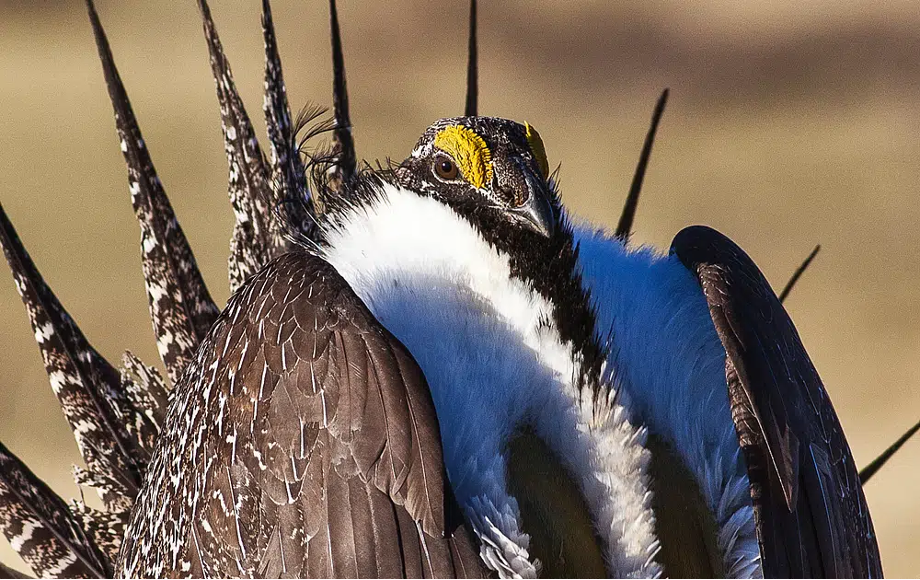
Greater Sage Grouse
The legal arguments surrounding the recission center species focus on currently listed threatened or endangered species. But dire consequences will also ensue for other species that are currently “stable.” These consequences include the destruction of the gate that once protected many species’ essential habitats, leaving them vulnerable to becoming threatened or endangered. One of these species teetering on the edge of threatened status for decades is the Greater Sage-Grouse (“sage grouse”).[20] Regular monitoring of sage grouse began in the 1950s and immediately documented a steady decline in population.[21]
Since the 1960s, sage grouse numbers have declined by an average of 2.3% per year.[22] In 2010, the Fish and Wildlife Service (FWS) determined the sage grouse warranted protection under the ESA, citing loss and fragmentation of habitat and a lack of adequate regulatory mechanisms to conserve habitat.[23] The FWS placed the sage grouse on the back burner and designated it a candidate species.[24] In response, the Bureau of Land Management (BLM) began to release a series of Environmental Impact Statements (EIS) to incorporate sage grouse conservation measures into their land use plans.[25] In September 2015, the FWS determined the sage grouse no longer required ESA protection due to BLM’s conservation plan and withdrew the species from the candidate list.[26] Despite the removal, subsequent projects happening near or on sage grouse habitat included explicit protections of sage grouse habitats in each project’s EIS.[27] Conservation efforts for the sage grouse did not lose momentum due to the threat of the harsher ESA regulations that would follow if the ESA were to protect the sage grouse. The recission has now dissolved these fears.
The Litigation Battle
Environmental groups and Tribal Nations now find themselves in the same position as developers 50 years ago. These groups filed lawsuits, all alleging similar violations under the Administrative Procedure Act (APA) and National Environmental Policy Act (NEPA).[28] The Services declined to produce an EIS or Environmental Assessment under NEPA, asserting that the recission is “a nondiscretionary action” and do not have the “authority to take environmental factors into consideration” and are therefore exempt.[29] Additionally, the Services cite a categorical exclusion from NEPA analysis reserved for “regulations . . . whose environmental effects are too broad, speculative, or conjectural to lend themselves to meaningful analysis and will later be subject to the NEPA process.”[30] The lawsuits alleged that the recission is not categorically excluded and even if the exclusion is applicable, the recission presents “extraordinary circumstances.”[31]
Extraordinary circumstances include actions that have “significant impacts on species listed, or proposed to be listed, on the Endangered or Threatened Species or have significant impacts on designated Critical Habitat for these species.”[32] Each lawsuit lists several species on the endangered or threatened species list under the ESA, explaining that removing key protections to their habitat would be detrimental to the species populations.[33] Indeed, several Tribal nations even state that such recission would violate certain treaties by no longer protecting species that the Tribe’s culture and economy rely on.[34]
Courts have historically favored executive agencies in NEPA and APA disputes.[35] Yet that trend raises an obvious question: why are so many plaintiffs now flooding the courts with lawsuits alleging the same violations? A promising theory is that the goal of the lawsuits is not to succeed in litigation but delay the application of the recission. The Breakthrough Institute (BI) compiled data on 387 NEPA cases that litigants brought to the U.S. appellate court system from 2013-2022.[36] BI concludes that NEPA litigation “overwhelmingly functions as a form of delay,” with most cases taking years before courts ultimately rule in favor of the defending federal agency.[37] Professor Patrick Parenteau of Vermont Law and Graduate School theorizes that the strategy of the challengers is to “delay litigation by filing lawsuits in multiple courts and asking . . . for preliminary injunctions to block the rule change pending the cases’ outcome.”[38] He theorizes that “the goal is to delay litigation,” thus delaying actual implementation of the rule, “to allow a future administration to reinstate the rule.” [39]
Conclusion
The litigation race has begun. The current administration undoubtedly hopes the Supreme Court will get to rule on the case before its time in office runs out. While it is unclear which side will prevail, the Greater Sage-Grouse and many other species now depend on this litigation. For now, the never-ending tug-of-war of politics and constantly changing administrations determines the fate of all wildlife. The Services avoided NEPA evaluations because they know that the scientific data will show how harmful indirect action is. The destruction of habitats is a death sentence for not only threatened and endangered wildlife, but for other wildlife that is currently “stable.” The ESA was created with the sole purpose of conserving the Nation’s wildlife and the Services’ recission of the “harm” definition violates the ESA by not only failing to conserve current endangered and threatened species but accelerating the damage on other vulnerable species—Greater Sage Grouse. The Services. must prioritize threatened and endangered species like the ESA requires and reinstate the “harm” definition.
[1] Complaint, Center for Biological Diversity v. Burgum, No. 2:26-cv-02474, at 21 (D. Wash. July 14, 2026).
[2] Rescinding the Definition of “Harm” Under the Endangered Species Act, 91 Fed. Reg. 43300, 43301 (July 14, 2026) (to be codified at 50 C.F.R. pts. 17, 222).
[3] Endangered Species Act of 1973, 16 U.S.C. § 1531(a) (1973). Congress further explained that the United States’s fish, wildlife, and plants have an “[a]esthetic, ecological, educational, historical, recreational, and scientific value to the Nation and its people.” Id. § 1531(a)(3).
[4] Id. § 1531(b) (1973). The ESA assigns the federal government the responsibility to ensure executive agencies’ actions do not adversely affect threatened or endangered species. Id. § 1536(a)(2). The ESA encourages the federal government to conserve threatened or endangered species. Id. § 1534(a). And prohibits all people—including private citizens—from “taking” endangered species. Id. § 1538(a).
[5] Id. at § 1532(19).
[6] Endangered and Threatened Wildlife and Plants; Final Redefinition of “Harm,” 46 Fed. Reg. 54748 (Nov. 4, 1981) (to be codified at 50 C.F.R. pt. 17).
[7] 91 Fed. Reg. 43301 (July 14, 2026).
[8] Babbitt v. Sweet Home Chapter of Cmtys. for a Great Or., 515 U.S. 687, 695 (1995).
[9] Id. at 703.
[10] Chevron, U.S.A., Inc. v. Nat. Res. Def. Couns., Inc., 467 U.S. 837, 842-43 (1984).
[11] Babbitt, 515 U.S. at 718 (Scalia, J., dissenting).
[12] Id. at 687-88.
[13] Loper Bright Enters. v. Raimondo, 603 U.S. 369, 411-12 (2024) (“to ‘ensure that the law . . . will develop in a principled and intelligible fashion’ is for us to leave Chevron behind”).
[14] Id. at 412 (“We do not call into question prior cases that relied on the Chevron framework”).
[15] 91 Fed. Reg. at 43301-02 (July 14, 2026).
[16] Id. at 43301.
[17] Id. (“We have concluded that the Services’ existing regulations . . . do not match the single, best meaning of the statute . . . [w]e adopt Justice Scalia’s rationale as articulated in Sweet Home”); Babbitt, 515 U.S. at 735 (“[H]abitat modification can constitute a ‘taking,’ but only if it results in the killing or harming of individual animals, and only if that consequence is the direct result of the modification”) (Scalia, J., dissenting).
[18] See Babbitt, 515 U.S. at 705 (criticizing Justice Scalia’s “selective foray into legislative history”).
[19] Id.
[20] Centrocercus urophasianus, U.S. Fish & Wildlife Serv., https://www.fws.gov/species/greater-sage-grouse-centrocercus-urophasianus (last visited Sept. 9. 2026).
[21] Id.
[22] Id.
[23] Endangered and Threatened Wildlife and Plants; 12-Month Findings for Petitions to List the Greater Sage-Grouse (Centrocercus urophasianus) as Threatened or Endangered, 75 Fed. Reg. 13910, 13910 (Mar. 23, 2010) (to be codified at 50 C.F.R. pt. 17).
[24] The FWS justifies this decision by the need to address higher-priority species. Id. at 14014.
[25] U.S. Department of the Interior Bureau of Land Management, Greater Sage-Grouse Rangewide Planning: Proposed Resource Management Plan Amendment and Final Environmental Impact Statement 1-2 (2024).
[26] Endangered and Threatened Wildlife and Plants; 12-Month Finding on a Petition to List Greater Sage-Grouse (Centrocercus urophasianus) as an Endangered or Threatened Species, 80 Fed. Reg. 59858, 59858 (Oct. 2, 2015) (to be codified at 50 C.F.R. pt. 17).
[27] See Final Environmental Impact Statement: Rhyolite Ridge Lithium-Boron Project, Bureau of Land Management, 3.12.1 (2022); see also Utah Final Supplemental EIS, Greater Sage-Grouse 2020, Bureau of Land Management, 3.3 (2020); see also Thacker Pass Lithium Mine Project: Final EIS, Bureau of Land Management, 42-45 (2020).
[28] See Complaint, Center for Biological Diversity v. Burgum, No. 2:26-cv-02474 (D. Wash. July 14, 2026); see also Complaint, Puyallup Tribe of Indians v. National Marine Fisheries, No. 3:26-cv-05788 (D. Wash. July 14, 2026); see also Complaint, Swinomish Indian Tribal Community v. National Marine Fisheries, No. 2:26-cv-02473 (D. Wash. July 14, 2026); see also Complaint, Nat’l Wildlife Fed’n v. U.S. Fish and Wildlife Serv., No. 2:26-cv-02897-RMG (D. S.C. July 17, 2026).
[29] 91 Fed. Reg. at 43307 (July 14, 2026).
[30] Id. at 43316.
[31] Complaint at 27, Center for Biological Diversity v. Burgum, No. 2:26-cv-02474 (D. Wash. July 14, 2026).
[32] Id.
[33] See Complaint, Center for Biological Diversity v. Burgum, No. 2:26-cv-02474 (D. Wash. July 14, 2026); see also Complaint, Puyallup Tribe of Indians v. National Marine Fisheries, No. 3:26-cv-05788 (D. Wash. July 14, 2026); see also Complaint, Swinomish Indian Tribal Community v. National Marine Fisheries, No. 2:26-cv-02473 (D. Wash. July 14, 2026); see also Complaint, Nat’l Wildlife Fed’n v. U.S. Fish and Wildlife Serv., No. 2:26-cv-02897-RMG (D. S.C. July 17, 2026).
[34] See Complaint at 0, Puyallup Tribe of Indians v. Nat’l Marine Fisheries, No. 3:26-cv-05788 (D. Wash. July 14, 2026); see also Complaint at 7-8, Swinomish Indian Tribal Cmty v. Nat’l Marine Fisheries, No. 2:26-cv-02473 (D. Wash. July 14, 2026).
[35] Nikki Chiappa, et al., Understanding NEPA Litigation: A Systematic Review of Recent NEPA-Related Appellate Court Cases 2 (2024).
[36] Id.
[37] Id.
[38] Patrick Parenteau, Why Trump’s move to gut the Endangered Species Act likely won’t hold up in court, The Conversation (July 17, 2026, at 08:13 ET), https://theconversation.com/why-trumps-move-to-gut-the-endangered-species-act-likely-wont-hold-up-in-court-287671.
[39] Id.