
Lithium Valley Project Dead in the Water?
By Jules Mulé
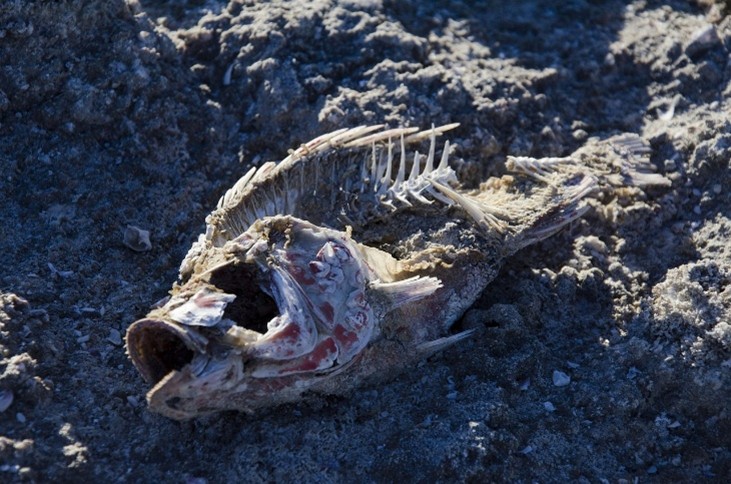
On the eastern border of California and Mexico lies the Sonoran desert’s hidden gem: the Salton Sea, the largest body of water in California.[1] It was formed in 1905 when the Colorado River flooded an irrigation canal servicing Imperial County farming communities.[2] From afar, the lake looks like an idyllic desert oasis. Up close, the Salton Sea is more akin to a harbinger of death. After decades of evaporation, the shrinking lake has bombarded residents with exposed pollutants from agricultural runoff that become airborne in toxic dust storms.[3] Constant exposure to these pollutants contributes to exceptionally poor air quality[4] and much higher rates of asthma than the national average.[5] Locals also face high poverty[6] and unemployment rates,[7] largely due to conservative-led immigration policy prioritizing border patrol.[8] But, there is hope for the residents of Imperial County, now known as the Lithium Valley.
The Salton Sea’s surrounding basin boasts geographical features that make it ideal for both geothermal energy production and direct lithium extraction.[9] Geothermal energy and lithium extraction are important tools for combatting climate change. Geothermal is a carbon-free renewable resource, and lithium is crucial for electrification because it is used in the large batteries found in electric vehicles and energy storage systems.[10] The most common method of lithium production is to evaporate large pools of brine, which involves significant freshwater consumption and pollution.[11] However, the geothermal energy plants around the Salton Sea present a unique opportunity for a cleaner method of lithium production. Geothermal plants use mineral-rich brine pumped up from beneath the Earth’s surface to generate electricity. This brine can be co-opted for “direct lithium extraction” before returning to the geothermal plant for subsurface reinjection.[12] Direct lithium extraction is currently the cleanest way to source lithium, as it extracts the lithium directly from the brine with minimal water loss.[13]
Only one domestic lithium mine is currently operational, so the United States is significantly dependent on the lithium from evaporation pools in Argentina and Chile.[14] Increasing domestic production would serve as an economic benefit, a supply security measure, and a step towards combatting climate change. These factors have led to an unprecedented amount of support from the federal,[15] state,[16] and local[17] governments for lithium production around the Salton Sea. The current administration also remains supportive of geothermal energy despite the largely negative treatment of decarbonization and renewable energy development.[18]
Controlled Thermal Resources (“CTR”) is determined to capitalize on the opportunity with the Hell’s Kitchen Project, a 50MW geothermal energy facility with large-scale direct lithium extraction facilities.[19] Hell’s Kitchen is estimated to generate 25,000 metric tons of lithium each year.[20] That much lithium would account for more than 10% of the global production in 2024.[21] However, there is substantial concern among community groups that local resident benefits are being overlooked and underprioritized.[22] Environmentalists are also concerned that risks associated with direct lithium extraction—especially water consumption and air pollution—are being ignored.[23] Motivated by these concerns, the Comité Cívico Del Valle (“CCV”) filed suit against CTR in the Imperial County Superior Court on March 13th, 2024.[24] The court dismissed the case in favor of CTR,[25] but CCV filed an appeal with California’s Fourth Appellate District nearly a year later.[26] In their brief, CCV claims that CTR had not conducted the environmental impact report properly, that they failed to account for the accurate scope of water use, and that they did not consult with local tribal leaders pursuant to California law.[27] CTR has until October 13th of this year to respond.
The lawsuit highlights a significant concern at the heart of the global climate crisis: how do we fight climate change without compromising on environmental justice? Decarbonization and electrification should counteract, rather than utilize, harmful environmental practices. Lithium batteries in electric vehicles and energy storage systems are crucial for decarbonization and electrification.[28] Accordingly, global production and consumption is projected to increase over 300% by 2030.[29] But importing nearly all of the lithium we’d need for these industries, as we do now, keeps the country dependent on fluctuating global supply generated by environmentally harmful traditional mining practices.
Domestic lithium production around the Salton Sea via direct extraction presents the unique opportunity to simultaneously increase supply security and promote a safer lithium extraction method. Domestic lithium production can also increase renewable energy development in the form of geothermal energy. However, there is equal opportunity to directly harm the Lithium Valley residents if environmental guidelines and community voices are ignored. To be done properly, mining operations in the Lithium Valley should be to the benefit of the local residents, not at their expense.
[1] Background Information on the Salton Sea, Cal. Dep’t Fish and Wildlife, https://wildlife.ca.gov/Regions/6/Salton-Sea-Program/Background (last visited Sept. 20, 2025).
[2] Id.
[3] Luke Runyon, How a Dying Lake in California Factors into the Colorado River’s Future, kbps (Mar. 21, 2018), https://www.kpbs.org/news/2018/mar/21/how-dying-lake-california-factors-colorado-rivers-/.
[4] Paul B. English, Imperial County Community Air Monitoring Project, Nat’l Inst. Env’t Health Sci.s (Apr. 12, 2021), https://www.niehs.nih.gov/research/supported/translational/community/imperial.
[5] Shohreh F. Farzan et al., Assessment of Respiratory Health Symptoms and Asthma in Children near a Drying Saline Lake, Int’l J. Env’t Rsch. and Pub. Health 1, 1 (2019).
[6] Arturo Bojórquez, Census: People in Poverty Increased by 22 Percent in the Imperial Valley, Imperial Valley Press (Feb. 6, 2024), https://www.ivpressonline.com/news/local/census-people-in-poverty-increased-by-22-percent-in-the-imperial-valley/article_033c96c4-c226-11ee-a16c-936f6a53fadd.html.
[7] Craig Johnson, The Story Behind the 20% Jobless Rate, Staffing Indus. Analysts (Oct. 8, 2024), https://www.staffingindustry.com/news/global-daily-news/the-story-behind-the-20-jobless-rate.
[8] Sasha Abramsky, Hard Times in the Imperial Valley, Cap. & Main (June 13, 2019), https://capitalandmain.com/hard-times-in-the-imperial-valley-0613.
[9] Patrick Dobson et al., Characterizing the Geothermal Lithium Resource at the Salton Sea 4 (2023).
[10] Marco Tedesco, The Paradox of Lithium, Columbia Climate Sch. Climate, Earth, and Soc’y: State Planet (Jan. 18, 2023), https://news.climate.columbia.edu/2023/01/18/the-paradox-of-lithium/.
[11] March Zheng, The Environmental Impacts of Lithium and Cobalt Mining, Earth.org (Mar. 31, 2023), https://earth.org/lithium-and-cobalt-mining/.
[12] Overview of Direct Lithium Extraction (DLE) from Salar Brine and Geothermal Brine, Sunresin, https://www.seplite.com/sunresin-direct-lithium-extraction/ (last visited Sept. 20, 2025).
[13] María L. Vera et al., Environmental Impact of Direct Lithium Extraction from Brines, 4 Nature Rev.s Earth and Env’t 149, 162 (2023).
[14] U.S. Geological Survey, U.S. Dep’t of the Interior, Mineral Commodity Summaries 110–11 (2025).
[15] Proclamation No. 14241, 90 Fed. Reg. 13673 (Mar. 25, 2025).
[16] Blue Ribbon Commission on Lithium Extraction in California Submits Final Report to State Legislature, Cal. Energy Comm’n (Dec. 1, 2022), https://www.energy.ca.gov/news/2022-12/blue-ribbon-commission-lithium-extraction-california-submits-final-report-state; Eric Everwine, State Allocates $10M to Support Lithium Valley Planning, Infrastructure, Calexico Chronicle (Mar. 24, 2025), https://calexicochronicle.com/2025/03/24/state-allocates-10m-to-support-lithium-valley-planning-infrastructure/?utm_campaign=desert-environmental-news-march-24-2025&utm_medium=newsletter&utm_source=desertenvironmentalnews.beehiiv.com.
[17] Developing Lithium Valley, Lithium Valley, https://lithiumvalley.imperialcounty.org/planning/ (last visited Sept. 20, 2025).
[18] Maria Gallucci, Geothermal Survives in ‘Big, Beautiful’ Budget Bill—but Hurdles Remain, CANARY MEDIA (July 9, 2025), https://www.canarymedia.com/articles/geothermal/enhanced-trump-bill-tax-credits.
[19] See Generally, CTR, U.S. Energy + Critical Minerals Powerfully Combined, https://www.cthermal.com/ (last visited Sept. 20, 2025).
[20] Id.
[21] U.S. Geological Survey, supra note 14.
[22] Manuel Pastor & Chris Benner, Big Lithium Plans for Imperial Valley, One of California’s Poorest Regions, Raise a Bigger Question: Who Should Benefit?, THE CONVERSATION (Sept. 26, 2024), https://theconversation.com/big-lithium-plans-for-imperial-valley-one-of-californias-poorest-regions-raise-a-bigger-question-who-should-benefit-238397
[23] Jared Naimark, Environmental Justice In California’s Lithium Valley 23–26 (2023).
[24] Community & Environmental Groups Issue Landmark Legal Challenge to Imperial Valley Lithium Project, EARTHWORKS (Mar. 14, 2024), https://earthworks.org/releases/community-environmental-groups-issue-landmark-legal-challenge-to-imperial-valley-lithium-project/
[25] Deborah Brennan, Massive Salton Sea Lithium Project Gets Judge’s Go-Ahead, Ending Advocates’ Lawsuit, CAL MATTERS (Jan. 29, 2025), https://calmatters.org/environment/2025/01/salton-sea-lithium-mining/.
[26] Deborah Brennan, When Lithium Mining Starts, Who Benefits, and Who’s at Risk? Inside this Salton Sea case, CAL MATTERS (Sept. 18, 2025), https://calmatters.org/environment/2025/09/when-lithium-mining-starts-who-benefits-and-whos-at-risk-inside-this-salton-sea-case/.
[27] Brief for Petitioner at 13, Comite Civico Del Valle v. County of Imperial, No. D085747 (Cal. Ct. App. Sept. 11, 2025).
[28] Tedesco, supra note 10.
[29] IEA, Global Critical Minerals Outlook 124–35 (2024).