
Insulating our own: How Zoning code Updates can Reduce heat Deaths in Maricopa County, Arizona
By Grace McGuire
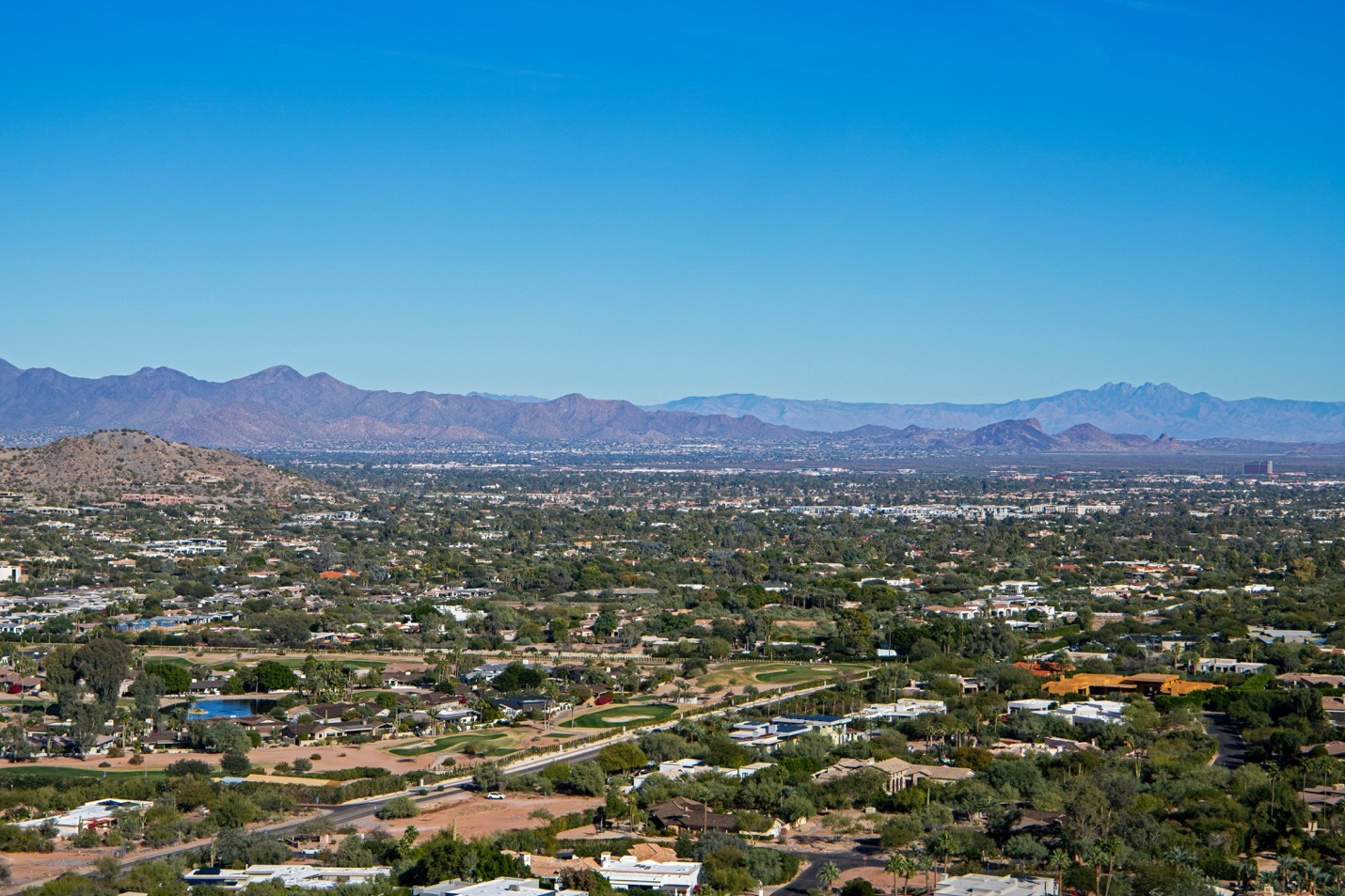
Spikes in summer temperatures leave urban dwellers across the globe in search of relief from heat exposure.[1] Desert regions like Arizona’s Maricopa County must address extreme heat through strategic zoning to protect marginalized populations from heat exposure and plan for a cooler urban future.
Arid urban areas experience compounded heat exposure because of their desert climates.[2] Arizona’s Maricopa County receives six months of extremely high heat; the metropolitan area undergoes 111 days of temperatures over 100°F.[3] Exposure to persistent heat can be deadly—in 2024, the Maricopa County Department of Public Health reported 608 heat-related deaths.[4] Over half of these deaths were among people aged 50 or older, and most occurred outside.[5] The prevalence of heat-related deaths is not region-specific; heat waves are the leading cause of all weather-related deaths worldwide.[6]
All cities retain more heat than natural landscapes. Unlike rural spaces where vegetation releases radiant heat through evapotranspiration, cities bake like dense ovens.[7] Building materials like concrete, brick, asphalt, and roof shingles absorb radiant energy from sunlight and store this energy at a higher rate than natural surfaces.[8] Cities become like “heat islands” because the built environment retains more heat than surrounding areas.[9] City-dwellers contribute to Heat Island effect while trying to avoid it—vehicles, air-conditioning units, buildings, and industrial facilities all emit even more heat into the urban environment.[10]
Maricopa County provides a valuable case study for desert cities experiencing negative public health impacts from the Urban Heat Island effect (UHI).[11] Researchers in Maricopa County studying heat deaths report three factors that influence an individual’s risk of heat casualty: (1) socioeconomic vulnerability, (2) elderly age and isolation, and (3) lack of vegetation.[12] These factors reveal financial resources (and the resulting access to housing, transportation, and amenities), nearby family or community members, and proximity to vegetative surfaces are powerful indicators of an individual’s resilience to heat-related death. While individual wealth is not a valid zoning-reform target,[13] zoning strategies can target the remaining two factors.
Heat “overlay zones” can enhance existing Euclidean zoning requirements by imposing new measures on development that target heat island effect.[14] For Maricopa County, such new measures should include increased vegetation through urban forestry and bonuses for developers creating low-income housing developments that prioritize communal green spaces. These two features would address two of the most relevant factors to heat-related deaths in the County.[15]
Maricopa County can create overlay zones by acting within the County’s state-granted zoning authority and in accordance with a comprehensive plan.[16] Notably, the County’s existing 2016 Plan is due for an update—Arizona State law requires the County to renew its comprehensive plan every ten years.[17] The County’s new comprehensive plan must coordinate with other existing municipal partners, namely cities existing within the County.[18]
One of the County’s municipal partners is the City of Phoenix. Phoenix is the largest city located within Maricopa County and currently has an action plan called “Shade Phoenix.“[19] Shade Phoenix recommends applying “$60 million in public and private investments . . . [to plant] 27,000 new trees and 550 new shade structures in Phoenix.”[20] By acknowledging the role that shade plays in preserving lives[21] the City of Phoenix has begun the task of implementing trees and shade structures into the urban landscape.
Maricopa County can work in concert with the City of Phoenix by adopting its own goals for increased vegetation through a zoning overlay district. Because the County is poised to adopt a new comprehensive plan, the County government can apply existing data on heat deaths[22] to influence policymaking targeting Urban Heat Island effect. After the County’s new comprehensive plan is in place in 2026, Maricopa County can require developers to plant a certain percentage of shade trees along sidewalks, setbacks, and medians, or require new construction to include a percentage of green space.[23]
The County can address disproportionate heat risks affecting isolated elderly people in urban areas by applying a “density bonus” for low-income and elderly housing developments that prioritize greenspace. Density bonuses are incentives for developers to build more units than would ordinarily be permitted by the underlying zoning district.[24] Bonuses allow local governments to achieve affordable housing goals by allowing high density buildings within designated zones. For example, California enabling legislature encourages low-income housing by mandating specific standards for California cities and counties in awarding density bonus applications to developers installing affordable units.[25] Affordable housing can provide elderly adults with a network of daily social interactions[26] and lessen the risk posed by extreme urban heat by bolstering social networks.[27] Maricopa County should create similar density bonuses to aid in the County’s public health heat strategy.
Density bonuses and Heat Island overlay zones are useful strategies in Maricopa County’s fight against heat deaths. These tools allow the County to address the heat risks faced by isolated, elderly populations by increasing vegetative cover and incentivizing dense, low-income housing communities. Maricopa County’s unique desert climate and modern urban infrastructure beget creative heat strategies that promote public health, safety, and welfare.[28] In doing so, the County can provide an example for other arid cities facing necessary code updates in the face of rising temperatures.
[1] Sharon L. Harlan et al., Neighborhood Effects on Heat Deaths: Social and Environmental Predictors of Vulnerability in Maricopa County, Arizona, 121 Env’t Health Persp. 197, 197 (2013) (noting most heat-related deaths occur in cities).
[2] Zachary W. Dichtl, Building Codes and Urban Heat Island Effect: An Analysis of the Impact of Building Codes on Temperature in Phoenix at the ZIP Code Level 29 (2023) (Graduate thesis, Ohio State University) (available at https://etd.ohiolink.edu/acprod/odb_etd/etd/r/1501/10?clear=10&p10_accession_num=osu1689928033715864).
[3] Id.
[4] Maricopa Cnty. Pub. Health, 2024 Heat-Related Deaths Report (2025) https://www.maricopa.gov/ArchiveCenter/ViewFile/Item/5934.
[5] Id.
[6] Dichtl, supra note 2, at 10.
[7] Jay S. Golden, The Built Environment Induced Urban Heat Island Effect in Rapidly Urbanizing Arid Regions – A Sustainable Urban Engineering Complexity, 1 Env’t Sci. 321, 327 (2003).
[8] Id.
[9] What Are Heat Islands?, EPA, https://www.epa.gov/heatislands/what-are-heat-islands (last visited Oct. 12, 2025).
[10]Id.
[11] Dichtl, supra note 2, at 9.
[12] Harlan et al., supra note 1, at 200.
[13] Thomas J. Albertson, Sustainable Housing in Three Steps Including Heat Island Overlay Zones, 39 J. Env‘t L. & Litig. 289, 297 (2024) (noting spot zoning is impermissible rezoning).
[14] Id.
[15] Harlan et al., supra note 1, at 200.
[16] Ariz. Rev. Stat. § 11–811(A).
[17] What Is a Comprehensive Plan?, Maricopa County, https://framework2040.com/about/ (last visited Oct. 12, 2025).
[18] Id.
[19] Shade Phoenix: An Action Plan for Trees and Built Shade, City of Phoenix (2024) BP_ShadePhoenixPlan_Report_031025_EN.pdf.
[20] Id. at 12.
[21] Id. at 4.
[22] Harlan et al., supra note 1, at 200.
[23] Albertson, supra note 13 at 328.
[24] Density Bonus, Inclusionary Housing, https://inclusionaryhousing.org/designing-a-policy/land-dedication-incentives/density-bonus/ (last visited Oct. 12, 2025).
[25] Cal. Gov’t Code § 65915 (a)(1) (Deering 2025).
[26] Housing for America’s Older Adults: Four Problems We Must Address, Harv. Joint Ctr. for Hous. Stud. (Aug. 18, 2022), https://www.jchs.harvard.edu/blog/housing-americas-older-adults-four-problems-we-must-address.
[27] Jessica Kutz, Social Isolation May Be Why Older Men Are Dying from Extreme Heat, Harv. Pub. Health (Oct. 15, 2024), https://harvardpublichealth.org/mental-health/social-isolation-may-be-why-older-men-are-dying-from-extreme-heat/.
[28] Ariz. Rev. Stat. § 11–811(A).