
Rights of Nature as an Alienating Step Towards Better Environmental Laws
By Brett Davis
Humanity continues failing to adequately protect world’s ecosystems despite years stewarding for the environment.[1] This failure poses devastating consequences to individuals, societies, and the world.[2] Nothing here is new; humankind has been aware of the cost of neglecting nature for thousands of years.[3] But this awareness has an anthropocentric tint in the modern age, which has informed environmental responses. To combat environmental failures that human-centered approaches bring, the “Rights of Nature” movement has emerged.[4] The movement attempts to redefine environmentalism to make nature a key player.[5] This blog will explore this attempt and provide a Marxist critique of a rights-centered approach to environmental law.
The Rights of Nature movement seeks to end the reductive view that nature is a mere sum of its parts.[6] The old Enlightenment view establishes humans as the environment’s master.[7] This mastery, paired with the idea of the wholly rational human, guided the law to treat nature as a tool for human needs.[8] During the late 20th century, industrial nations began adopting a stewardship approach, placing humans as nature’s protectors.[9] While more environmentally conscious, stewardship has still failed to protect Earth’s ecosystems.[10] The problem is that humans are still the masters of nature, and stewardship still reduces nature to human-defined values. Thus, the Rights of Nature focuses on establishing rights for nature itself¾rights that are defendable in court.[11]
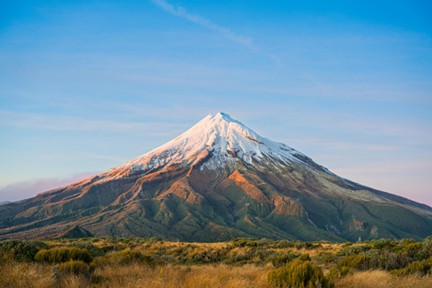
Defendable rights take a legally human form. Recently, New Zealand’s Taranaki Maunga (or Mount Taranaki) was recognized as a legal person.[12] Taranaki joins a list of natural features with personhood in the New Zealand, a world leader in the Rights of Nature.[13] The hope is personhood will help to conserve and restore traditional Māori uses.[14] Members of Māori iwi will be “the face and voice” of Taranaki Maunga and will oversee the rights, powers, duties, responsibilities, and liabilities of the mountain.[15] Using a group of trustees representing a natural personhood is a common approach under the Rights of Nature.[16]
The personhood these trustees protect is one Marxism has long critiqued. Marx critiqued rights as separating individuals from their community.[17] The purely Marxist understanding is that the bourgeoisie favored individual rights undermine the proletariat’s interests in a unified class.[18] Now, modern theorists have expanded the alienating effect of individualism to anti-colonialism, feminism, and more.[19] The root issue of all these movements is clear: rights alienate people and deny the intersectionality arising from human issues.
Rights of Nature are no different than these human rights¾rights alienate nature from itself. Rights establish each actor in a system as distinct, manageable, and understandable. Each piece of nature may receive personhood and subsequent rights,[20] but nature is not a series of distinct persons. This tension, between nature’s reality and right’s unreality, poses serious strains on the framework’s solvency. How do a river’s rights relate to those of a migratory species that occasionally calls the river home? Both entities are simply together in nature. Enlightenment rationalism does not clearly apply to such interconnected systems. Nature does not prioritize one part of itself over another. Proscribing rights to nature creates environmental components as competitive agents in a larger rights system.
In the competitive system, rights act as “trumps,” some rights taking priority over others.[21] A priority of rights leads to balancing, an already contentious point in environmental policymaking.[22] Any current American political issue—freedom of speech, privacy, pro-choice, racial and wealth inequality—highlights the impasse of people’s rights against each other and the state. Nature’s components will just be a new agent in the constant balancing of rights.
This balancing goes to Marx’s concern.[23] How does nature, a collective, integral, and abstract entity, compete with individual rights? How can a river assert a right over the people who use the river for their livelihoods? This is the same problem. No person functions absent of nature, and nature is not complete absent people. Nature’s rights create a nonexistent antagonism: what is best for nature is contrary to what is best for people. And this conflict is the very goal of Rights for Nature, to create a system for nature to “fight” for itself.[24]
The Rights of Nature aim for conflict in the current system, contrasting the utopian ends of Marxism. Supplying nature with the right to defend itself allows for a better functioning status quo. Namely, personhood allows environmental claims a way around typically difficult standing challenges.[25] Additionally, Rights of Nature can help quell the anthropocentric views on the environment prevalent in the West.[26] In these ways, the movement is a steppingstone to better evaluating nature’s importance. But a steppingstone is not an end.
We must ask whether a system of rights that has led to such devastating environmental catastrophes is the system that will truly be able to represent nature. Rights fix nature into the enlightenment system; it does not radically redefine how we approach problems. We live in a world where human rights abuses are still ubiquitous, even in democratic societies.[27] The Marxist critique is one way to explain these failures, and how the Rights of Nature might fall into the same historical struggle. But understanding rights power to alienate right holders underscores the frameworks shortcomings in uniting and caring for nature. The Rights of Nature do not supply the ends for environmental response but are simply a possibly misguided step towards equitable ends.
[1] Sandra Díaz, et al. The Global Assessment Report on Biodiversity and Ecosystem Services, XIV (Eduardo S. Brondízio et al. eds, IPBES, 2019).
[2] Id.
[3] Ryan Weyler, A Brief History of Environmentalism, GREENPEACE, (Jan. 5, 2018) https://www.greenpeace.org/international/story/11658/a-brief-history-of-environmentalism/.
[4] Karen Bradshaw, Identifying Contemporary Rights of Nature, 95 S. Cal. L. Rev. 1439, 1446 (2022).
[5] See id.
[6] Niels Hoek, et al., Implementing Rights of Nature: An EU Natureship to Address Anthropocentrism in Environmental Law, 19 Utrecht L. Rev. 72, 74 (2023).
[7] Id. at 75.
[8] Id.
[9] Id.
[10] Díaz supra note 1 at XIV.
[11] Hoek, et al. supra note 6 at 75.
[12] Charlotte Graham-McLay, A New Zealand mountain is granted personhood, recognizing it as scared for Māori, AP (Jan. 31, 2025), https://apnews.com/article/mountain-zealand-personhood-maori-taranak-590fca0f3d648cc0bf86d970782e954c.
[13] Id. (joining Te Urewera Forest and Whanganui River).
[14] Id.
[15] Id.
[16] Hoek, et al. supra note 6 at 75.
[17] Karl Marx, On the Jewish Question (1844), https://www.marxists.org/archive/marx/works/1844/jewish-question/ (last visited Oct. 12, 2025).
[18] Id.
[19] See generally Vasuki Nesiah, The Ground Beneath Her Feet: “Third World” Feminisms, 4 J. Int’l Women’s Stud. 30 (2003); Kimberle Crenshaw, Mapping the Margins: Intersectionality, Identity Politics, and Violence against Women of Color, 43 Stan. L. Rev. 1241 (1991); Makau Mutua, Savages, Victims, and Saviors: The Metaphor of Human Rights, 42 Harv. Int’l L. J. 201 (2001).
[20] Graham-McLay supra note 12.
[21] Mauricio Guim & Michael A. Livermore, Where Nature’s Rights Go Wrong, 107 Va. L. Rev. 1347, 1370 (2021).
[22] Id. at 1370-74.
[23] See Marx supra note 17.
[24] See Bradshaw supra note 4 at 1449.
[25] See Marisa Martin & James Landman, Standing: Who Can Sue to Protect the Environment?, Insights on Law & Society, Vol. 19 2020, https://www.americanbar.org/groups/public_education/publications/insights-on-law-and-society/volume-19/insights-vol–19—issue-1/standing–who-can-sue-to-protect-the-environment-/ (discussing standing issues in environmental law).
[26] See Bradshaw supra note 4 at 1449.
[27] See generally Human Rights Watch, World Report 2024: Events of 2023 (2024).