
Peaks and Paperwork: Recreation and Administrative Law in the Adirondacks
By: Jordan Young
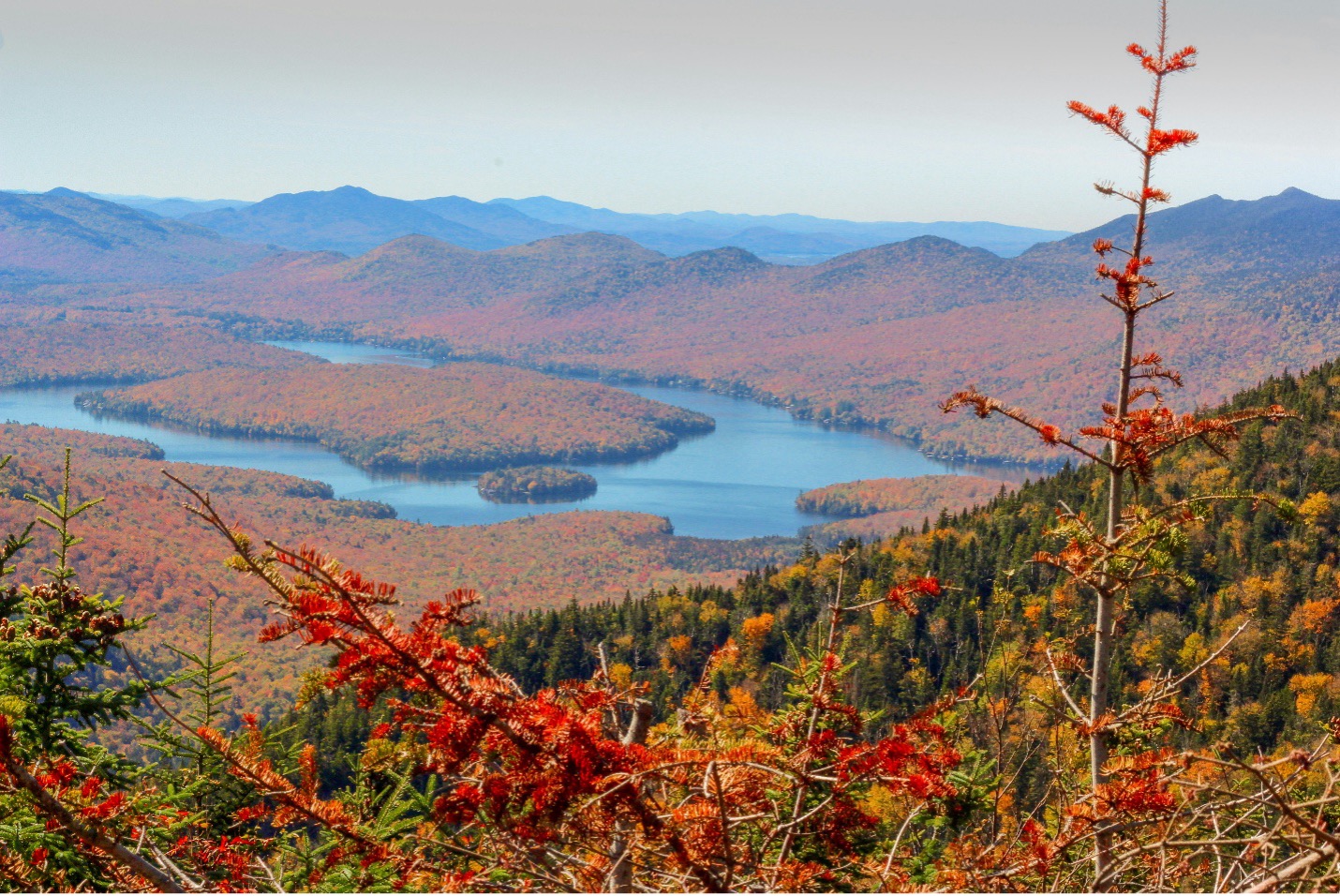
The Adirondacks, An Introduction:
In 1892, the New York State Legislature passed the Adirondack Park Act, officially establishing the Adirondack Park Preserve.[1] Mountains, forests, rivers, streams, and towns make up the six million acres of parkland.[2] Two million nine hundred thousand acres of this land is publicly protected forest preserve.[3] The split between public and private land has created a dual administrative framework. The Adirondack Park Agency (“APA”) primarily oversees private land administration,[4] and the Department of Environmental Conservation (“DEC”) primarily oversees public land conservation.[5] However, these two agencies often overlap in both public and private land management.[6] To reduce administrative confusion, the APA and DEC work together to create policy frameworks that outline agency responsibility in the park.[7] While the park dates back to the late 19th century, this complex framework is relatively modern.[8]
Planning Out the Park
In 1971, the New York Legislature enacted the Adirondack Park Agency Act, creating the APA.[9] The agency’s purpose was to create a regional framework that would balance the park’s conservation goals with the development interests of local town governments.[10] Since 1972, the APA has written master plans to guide park administration.[11] These plans cover a range of topics, from broadly classifying state land characteristics to narrowly defining how many miles of foot trails there are on any given mountain.[12]
The APA also oversees land development projects which may impact tourism and define the recreational activities available within the region. For example, the APA is responsible for all Class A and Class B regional projects.[13] Class A projects are geared towards larger commercial developments and structures, including residential subdivisions.[14] Class B projects encompass moderate intensity use areas, which include any tourist attractions or ski centers.[15] This system allows the APA to determine which infrastructure projects are approved, and as a result, to define what tourism looks like for the region.
Preserving the Park
On the other side of the administrative coin, the DEC upholds New York’s environmental policy.[16] That policy is to “improve and protect its natural resources and environment and to prevent, abate and control water, land and air pollution, in order to enhance the health, safety and welfare of the people of the state and their overall economic and social well [sic] being.”[17] The DEC is also tasked with encouraging development that maximizes environmental benefits within the state.[18] Within the Adirondacks, the DEC oversees the 2.9 million acres of forest preserve land.[19] To effectively oversee the large amount of land, the DEC has developed Unit Management Plans.[20] These plans include an ecosystem analysis, an infrastructure inventory, public use assessments, and area management objectives.[21] These plans aid the agency in determining critical areas of environmental concern and guide responsive action. For example, in the High Peaks Wilderness Unit, the Dix Mountain Tract limits group sizes to a maximum of 15 hikers and 8 campers due to environmental concern.[22] Unlike the APA, the DEC’s authority has a direct impact on day-to-day recreation in the park.
A Wild Past
Adirondack Park oversight falls on both the APA and DEC. However, one other law significantly impacts Adirondack development. In 1894, soon after establishing the Adirondack Park Preserve, the New York State legislature amended its state constitution.[23] Article XIV mandates that state forest preserves, which includes the Adirondack Park,[24] are to be “forever kept wild,”[25] Recently, this mandate has been used by a conservation interest group to litigate against a proposed development project in the Adirondacks.[26]
A Forever Wild Future?
The APA regulatory framework was designed to balance both the private and public land interests of conservation and development.[27] As modern recreation often falls between these two objectives, courts are tasked with determining if recreational projects are permissible or unconstitutional.[28] Instead of relying on the judicial process to address these conflicts, New York should modernize the APA’s regulatory framework to account for modern recreational developments while still adhering to Article XIV’s mandate.
[1] About the Adirondack Park, Adirondack Park Agency https://apa.ny.gov/about/park.html (last visited Sept. 11, 2026).
[2] Id.
[3] Adirondack Park Agency, Adirondack Park State Land Master Plan 3 (2025) [hereinafter Master Plan].
[4] Id.
[5] See N.Y. Env’t Conserv. law § 9-0105(1).
[6] See Adirondack Park Agency & Dep’t of Env’t Conservation, Memorandum of Understanding Between the Adirondack Park Agency and the Department of Environmental Conservation Concerning Implementation of the State Land Master Plan for the Adirondack Park 2 (2010) [hereinafter MoU].
[7] See Master Plan supra note 3; MoU supra note 6.
[8] N.Y. Exec. law §§ 800-820 (McKinney 1971).
[9] Id.
[10] Id. at § 801.
[11] Master Plan at 1.
[12] “THE ACT Requires the Agency to classify the state lands in the Park . . .” Master Plan supra note 3 at 16; The plan outlines statistics of Giant Mountain, including it has 33 miles of Foot Trails. Master Plan supra note 3 at 64.
[13] N.Y. Exec. law § 810 (McKinney 2011).
[14] Id. at § 810(a).
[15] Id. at § 810(b)(6), (b)(7).
[16] N.Y. Env’t Conserv. law § 3-0301(1).
[17] N.Y. Env’t Conserv. law § 1-0101(1).
[18] N.Y. Env’t Conserv. law § 3-0301(1)(g).
[19] Master Plan supra note 3, at 2.
[20] Id. at 10.
[21] Id. at 10-12.
[22] Backcountry Information For The Adirondack Park, Dep’t of Env’t Conservation, https://dec.ny.gov/things-to-do/hiking/adirondack-backcountry/backcountry-information-for-adirondack-park (last visited Sept. 12, 2026).
[23] One Hundred and Thirty Years Later, Adirondack Council, https://archive.adirondackcouncil.org/news/one-hundred-and-thirty-years-later-1619.html (last visited Sept. 12, 2026).
[24] Id.
[25] N.Y. Const. art. XIV, § 1.
[26] See generally Protect the Adirondacks! Inc. v. N.Y. Dep’t of Env’t Conservation, 147 N.E.3d 73 (N.Y. 2021) (holding 27 miles of planned snowmobile trails violated the New York Constitution’s “forever wild” clause).
[27] See N.Y. Exec. law §§ 800-820 (McKinney 1971).
[28] Id.