
Hoosier Wetlands
By Neil Goswami
Introduction
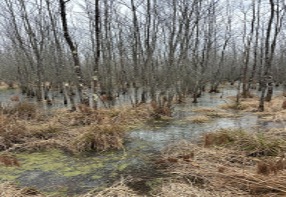
Indiana’s wetlands constitute vital habitat for myriad species of native flora, mammals, fish, amphibians, reptiles, birds, and insects.[1] Some of Indiana’s wetlands are ephemeral—holding water only during certain weeks and months of the year—while others are more permanent.[2] Some abut rivers, ponds, and lakes,[3] while those lacking surface water connection to other waters or wetlands are considered “isolated.”[4] Bogs, fens, swamps, marshes, mudflats, coastal wetlands, and vernal pools form diverse ecosystems with unique communities of plants and animals.[5] Dragon’s mouth orchids, lance-leaved burheads, bowfins, grass pickerels, leopard frogs, spotted turtles, black terns, beavers, and star-nosed moles are among the species that are native to Indiana wetlands.[6] Due to the drainage of wetlands and other anthropogenic habitat loss, some of those species are rare, threatened, endangered, or extirpated. [7]
In addition to their role as habitat, Indiana wetlands—like other wetlands—provide beneficial ecosystem services. They serve as natural forms of flood control, offer aesthetic and recreational value, contribute to ecotourism, filter toxic chemicals from agricultural runoff, and prevent erosion.[8] Wetlands globally provide trillions of dollars’ worth of ecosystem services each year.[9] In light of the ecological significance and natural economic benefits of Indiana wetlands, regulating their protection is deeply important. Yet, the combined effects of recent Supreme Court jurisprudence[10] and harmful regulatory decisions made by the second Trump Administration[11] have left portions of Indiana wetlands without meaningful protections at the federal level.
I. Sources of Federal Regulation
The Endangered Species Act
The Endangered Species Act (ESA) is one source of federal legislation that has protected some of Indiana’s rare, threatened, and endangered wetland species.[12] The Act prohibits “taking” endangered species of fish and wildlife unless authorized by a permit.[13] The Act includes “harm” in its definition of “take.”[14] The Act covers the removal of endangered plant species insofar as the removal occurs on lands subject to federal jurisdiction.[15]
For decades, the Fish and Wildlife Service included habitat destruction in its interpretation of “harm.”[16] This meant that the ESA indirectly protected Indiana wetlands providing habitat for federally listed wildlife. To the detriment of wetlands and their communities, in April 2025, the Trump administration proposed the wholesale removal of regulations interpreting “harm” under the Endangered Species Act.[17] The rule change poses a significant threat to Indiana wetlands providing habitat for listed species. Under the rule change, developers could bulldoze Indiana wetlands home to endangered wetland species and—as long as they didn’t intentionally kill or trap the endangered species—escape regulatory oversight.[18] To the detriment of Indiana’s wetlands and their endangered species, that proposed rule went into effect September 14, 2026. [19]
The Clean Water Act
The Clean Water Act (CWA) is another source of federal legislation that regulates some of Indiana’s wetlands to varying degrees. The CWA prohibits the discharge of pollutants into navigable waters unless authorized by a permit.[20] It establishes two primary permitting programs: Section 404 for the discharge of dredged or fill material[21] and Section 402 for the discharge of other pollutants.[22] The Act defines navigable waters as “waters of the United States.”[23] For decades, determining which bodies of water are included in this definition has been the subject of intense litigation.[24]
In U.S. v. Riverside Bayview Homes, the U.S. Army Corps of Engineers (the Corps) filed suit against a developer who placed fill material in a low-lying marshland near Lake Saint Clair, a navigable water in Michigan.[25] The case went to the Supreme Court, where it interpreted navigable waters to include wetlands adjacent to waters of the United States.[26] The Court rejected the “simplistic” linguistic argument that wetlands cannot be classified as “waters” because they are “lands.”[27] Relying on legislative history emphasizing the Act’s protective purpose, the Court determined that by defining navigable waters as “waters of the United States,” Congress had intended for the Act to cover waters broadly.[28] Applying Chevron’s deference standard,[29] the Court held that the 1975 regulation including wetlands adjacent to navigable waters was reasonable.[30] This was great news for environmentalists. The Court had recognized that superimposing artificial boundaries does not sever the ecological connection between wetlands and nearby waters.[31] For Indiana’s wetlands, this meant federal permitting requirements could extend beyond traditionally navigable waters to include nearby wetlands. In the decades that followed, this expansive view of jurisdictional waters would be whittled away.
In SWANCC, the Supreme Court excluded from jurisdictional wetlands those without a “significant nexus” between the wetland and navigable waters.[32] Five years later, a plurality opinion held that the Act covered “only relatively permanent” bodies of water with a “continuous surface connection” to navigable waters.[33] That same case produced Justice Kennedy’s “significant nexus” test — which built upon the language of SWANCC and determined that mere adjacency or hydrological connection to navigable water is an insufficient jurisdictional basis.[34] One piece of jurisprudence appeared to strengthen protections. In 2020, the Court held that a defendant who discharged pollutants into groundwater that traveled a half-mile to the ocean could be held liable under the CWA because the pollutant’s migration through groundwater was a “functional equivalent of a direct discharge” into navigable water.[35] But in 2023, the Supreme Court dropped a bombshell.
In Sackett v. Environmental Protection Agency, the Court eviscerated what was left of the significant nexus test, holding that the CWA covered only those wetlands that had a “continuous surface connection” with waters of the United States such that “they are ‘indistinguishable’ from those waters.”[36] Before Sackett, around 80% of Indiana’s wetlands were covered under the CWA.[37] Today, the Act covers only 20% of Indiana wetlands—amounting to a staggering 75% reduction in coverage.[38]
II. Where Things Stand in Indiana
Despite these deregulatory trends at the federal level, the Indiana General Assembly has largely failed to provide meaningful protections to Indiana’s wetlands. While states like Vermont actively protect vernal pools,[39]these wetlands generally fall outside of Indiana’s wetland classification scheme.[40] One plain reading of an Indiana statute and its relevant definition provision exempts vernal pools from fill permits altogether.[41] A series of other Indiana laws enacted throughout the 2020s further reduced Indiana wetland protection.[42] The result is a widening regulatory gap. For Indiana’s remaining wetlands, swift legislative action is vital to preserve their ecosystems and ecosystem services.
[1] See Habitats and Ecological Communities of Indiana: Presettlement to Present 97–113 (John O. Whitaker, Jr. et al eds., 2012) (describing the kinds of flora and fauna in Indiana wetlands).
[2] Id. at 97.
[3] Id.
[4] Ralph W. Tiner, Geographically Isolated Wetlands of the United States, 73 Wetlands No. 3 494, 495 (2003).
[5] Whitaker, Jr. et al., supra note 1 at 97.
[6] Id. at 99–102.
[7] Id. at 98.
[8] Stephen M. Johnson, Wetlands Law: A Course Source 1–8 (CALI eLangdell Press 6th ed. 2025).
[9] Id. at 1 (citing Wetland Ecosystem Services – an introduction, Ramsar:The Convention on Wetlands) (available at https://www.ramsar.org/sites/default/files/documents/library/services_00_e.pdf).
[10] See, e.g., Sackett v. Environmental Protection Agency, 598 U.S. 651, 678–79, 684 (2023) (narrowing the scope of jurisdictional wetlands).
[11] See 91 Fed. Reg. 43300 (Jul. 14, 2026) (to be codified at 50 C.F.R. pts. 17, 222) (rescinding the regulatory definition of “harm” under the Endangered Species Act).
[12] 16 U.S.C. §§ 1531–1544.
[13] Id. § 1538.
[14] Id. § 1532.
[15] Id. § 1538(a)(2).
[16] 50 C.F.R. § 17.3.
[17] Supra note 11.
[18] Cf. Jessica R. Graham, Worth a Double Take: The Removal of “Harm” from the Endangered Species Act, 52 Ecology L. Currents 15, 17 (2025) (arguing that a developer intending to develop land possessing a grey wolf den could bulldoze the wolf den and escape regulatory oversight under the rule change).
[19] Supra note 11.
[20] 33 U.S.C. §§ 1311(a), 1362(12).
[21] Id. § 1344.
[22] Id. § 1342.
[23] Id. § 1362(7).
[24] See generally United States v. Riverside Bayview Homes, Inc., 474 U.S. 121 (1985) (holding a more expansive interpretation of “waters of the United States” under the Clean Water Act); Solid Waste Agency of Northern Cook County v. U. S. Army Corps of Engineers, 531 U.S. 159 (2001); Rapanos v. United States, 547 U.S. 715 (2006) (plurality opinion); Cnty. of Maui v. Hawaii Wildlife Fund, 590 U.S. 165 (2020); Sackett v. Environmental Protection Agency, 598 U.S. 651 (2023) (narrowing jurisdictional waters under the Clean Water Act).
[25] 474 U.S. at 124.
[26] Id. at 138–39.
[27] Id. at 132.
[28] Id. at 132–33.
[29] Id. at 132.
[30] Id. at 139.
[31] Id. at 133–34.
[32] Solid Waste Agency of Northern Cook County v. U.S. Army Corps of Engineers, 531 U.S. 159, 167, 170–171 (2001).
[33] Rapanos v. United States, 547 U.S. 715, 742, 749 (2006) (plurality opinion).
[34] Id. at 782–83, 786 (Kennedy, J., concurring).
[35] Cnty. of Maui v. Hawaii Wildlife Fund, 590 U.S. 165, 183–84 (2020).
[36] Sackett v. Environmental Protection Agency, 598 U.S. 651, 684 (2023).
[37] A Timeline of Indiana Wetland Regulation, Hoosier Env’t Council: Protecting Indiana’s Isolated Wetlands, https://www.hecweb.org/issues/water-wilderness/water-protection/protecting-wetlands/.
[38] Id.
[39] Emily Anderson, How States Like Vermont Fill the Gaps in Wetland Protection, Vt. Ctr. for Ecostudies (Oct. 20, 2025) https://vtecostudies.org/blog/states-vermont-wetland-protection.
[40] Vernal Pools in Indiana: A Hidden Ecological Gem, Hoosier Environmental Council (May 30, 2025) https://www.hecweb.org/2025/05/30/vernal-pools-in-indiana-a-hidden-ecological-gem/.
[41] Ind. Code § 13-18-22-1(b)(6).
[42] A Timeline of Indiana Wetland Regulation, supra note 37 (discussing the passage of S.E.A. 389 and H.B. 1383).